
Home                           

 Try Investor/RT             

 Investor/RT Tour           

 Getting Started              

 What's New                  

 Testimonials                 


MASTER INDEX
  SEARCH
  CHARTS
  MAIN TOOLBAR
  SETTING PREFERENCES
  TECHNICAL INDICATORS
 
WHAT'S NEW
  ALARMS
  BACKTESTING

  CONFIRMING TRADES
  CUSTOM COLUMNS
  CUSTOM INDICATORS
  CUSTOM INSTRUMENTS
  CUSTOM PRICES
  DATA FEEDS
  DATABASE
  DOWNLOADING DATA
  FEED STATUS
  HEARTBEAT
  HELP
  MULTI-LINKING
  MULTI-PERIODICITY
 
INSTRUMENT SETUP
 
NASDAQ LEVEL II
 
NEWS TICKER
 
NEWS BROWSER
  OPTIMIZATION
  OPTIONS ANALYTICS

  PLACING TRADES
  PORTFOLIOS
  PRESETS
 
PRINTING
  QUICK QUOTES
  QUOTE PAGES
  REALIZATION
  RTL LANGUAGE
  SCANS
  SCHEDULES

  SCOPE
  SYSTEM STATUS
  TICKER TAPE
  TIME AND SALES

 
TRADING NOTES
  USER VARIABLES
  VERTICAL SCALE
MASTER INDEX
DICTIONARY
FEEDBACK

Investor/RT Tour ( more on Technical Indicators )
Arms Ease of Movement
The Formula . . . 

. . .more on Formulas 

EMV = [(HI + LO)/2 - (HI.1 - LO.1)/2] / [VOL/(HI - LO)]

where
   VOLADJ = VOLUME / VOLDIVISOR

 
The Presentation . . . 

. . . more on Charts 

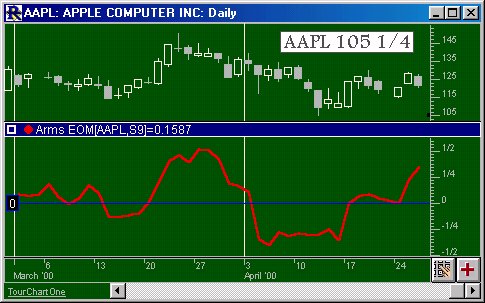
Arms Ease of Movement

Above is a Daily Chart of Apple Computers (AAPL).  The red line in the lower window pane represents the Arms Ease of Movement, as specified in the preferences below.
 
The Preferences . . . 

. . . more on Preferences 

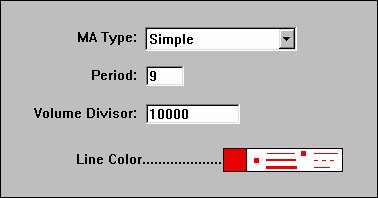
Arms Ease of Movement Preferences

  • MA Type - Smoothing type, smoothing is applied the the EMV vales, if you prefer no smoothing, the place a 1 in the Period.

  • Period - Smoothing Period.

  • Volume Divisor - This divisor is used to bring the volume down to a more reasonable number in the above calculation of the EMV.

  • Line Color - Color of the EMV line in the chart.

 
The Description . . .
The Arms' Ease of Movement Value (EMV) is a momentum indicator developed by Richard W. Arms, Jr. The indicator takes into account both volume and price changes to quantify the ease (or difficulty) of price movements. 

The calculation is as follows: 

EMV = (HI + LO)/2 - (HI1 - LO1)/2 all divided by VOL/(HI-LO) 

HI, LO, VOL are the high, low, and volume for the current period HI1 and LO1 are the high and low for the previous period 

The volume is scaled by dividing by a constant divisor, usually 10000. This divisor may be varied by the user in the Arms EMV setup. If the EMV line appears flat, try increasing the divisor by a factor of 10 or 100. 

The Arms EMV values for each period are then smoothed with a moving average. The period and type of moving average smoothing are user specified in the Arms setup window. 

The smoothed Arms EMV line oscillates around zero. The decision rule is to buy when EMV goes positive and sell when it goes negative. This indicator is seldom used by itself, but as a confirming indicator in concert with other signals.