
Home                           

 Try Investor/RT             

 Investor/RT Tour           

 Getting Started              

 What's New                  

 Testimonials                 


MASTER INDEX
  SEARCH
  CHARTS
  MAIN TOOLBAR
  SETTING PREFERENCES
  TECHNICAL INDICATORS
 
WHAT'S NEW
  ALARMS
  BACKTESTING

  CONFIRMING TRADES
  CUSTOM COLUMNS
  CUSTOM INDICATORS
  CUSTOM INSTRUMENTS
  CUSTOM PRICES
  DATA FEEDS
  DATABASE
  DOWNLOADING DATA
  FEED STATUS
  HEARTBEAT
  HELP
  MULTI-LINKING
  MULTI-PERIODICITY
 
INSTRUMENT SETUP
 
NASDAQ LEVEL II
 
NEWS TICKER
 
NEWS BROWSER
  OPTIMIZATION
  OPTIONS ANALYTICS

  PLACING TRADES
  PORTFOLIOS
  PRESETS
 
PRINTING
  QUICK QUOTES
  QUOTE PAGES
  REALIZATION
  RTL LANGUAGE
  SCANS
  SCHEDULES

  SCOPE
  SYSTEM STATUS
  TICKER TAPE
  TIME AND SALES

 
TRADING NOTES
  USER VARIABLES
  VERTICAL SCALE
MASTER INDEX
DICTIONARY
FEEDBACK

Investor/RT Tour ( more on Technical Indicators )
On Balance Volume
The Formula . . . 

. . .more on Formulas 

Not Cumulative, Not Normalized
SUM{UVOL, Period} - SUM{DVOL, Period}
Cumulative, Not Normalized
SUM{UVOL} - SUM{DVOL}
Cumulative, Normalized
100 * (SUM{UVOL} - SUM{DVOL}) / SUM{VOL}
Not Cumulative, Normalized
100 * (SUM{UVOL, Period} - SUM{DVOL, Period}) / SUM{VOL, Period}

   where
   UVOL = Up Volume = Volume when CL > CL.1
   DVOL = Down Volume = Volume when CL < CL.1
   Note: When the "Cumulative" option is checked, the period is not considered, and the OBV is computed using all previous data (essentially, a period that begins at 1 and increases by 1 each bar).  Also, when the "Normalized" checkbox is checked, the result is divided by the total volume of the period (or all previous volume if cumulative), and then multiplied by 100.
 
The Presentation . . . 

. . . more on Charts 

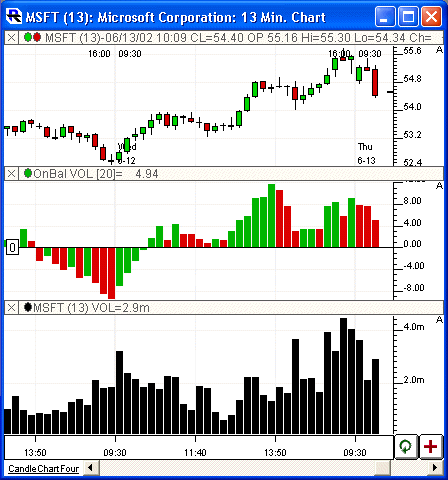
On Balance Volume Chart

Above is a 15 Minute Bar Chart of a Intel Corporation (INTC).  The bold green line in the lower window pane represents the On Balance Volume line based on the preferences below.

 
The Preferences . . . 

. . . more on Preferences 

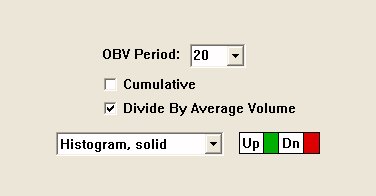
On Balance Volume Preferences

  • OBV Period - Number of periods over which to sum the up and down volumes.

  • CumulativeWhen the "Cumulative" option is checked, the period is not considered, and the OBV is computed using all previous data.  When "Cumulative" is unchecked, OBV will only consider the volumes over the previous OBV period.  When this checkbox is checked, the "OBV Period" control is disabled since it is not considered.

  • Normalized - If this checkbox is checked, the result will be divided by the total volume over the period (or over all previous bars if cumulative) and then multiplied by 100.  The result is an oscillator that ranges between extreme values of -100 and +100.

  • Draw Type - OBV can be drawn as either a histogram (solid or hollow) or a line (continuous or connected).

 
The Description . . .
The On Balance Volume (OBV) for an n-day period is defined as the sum of all volumes for up days minus all volumes for down days. An up day is one where the price closed higher or the same as the previous day. The On Balance Volume study calculates the n-day OBV for each day and charts it as a line or histogram which can oscillate around the zero line.

A "Cumulative" option forces the OBV to consider all previous data when calculating, as opposed to only the previous period.  The OBV values accumulate throughout the chart.  If the "Cumulative" option is unchecked, the user may specify a period over which the OBV will be calculated.

A "Normalized" checkbox option is available which results is an oscillator that ranges between extreme values of -100 and +100.  The OBV is normalized by first dividing the result by the total volume, and then multiplying by 100.  When "Cumulative" is checked, the total volume is the sum of the volume of all previous bars.  When "Cumulative" is unchecked, the total volume is the sum of the volume of the bars in the previous period.  A normalized result of +100 would mean that each bar over the period was an up bar, and therefore all volume was considered up volume.  Similarly, a value of -100 would mean that each bar over the period was an down bar, and therefore all volume was considered down volume.  A value of 0 would represent an even mixture of up volume and down volume over the period.