
Home                           

 Try Investor/RT             

 Investor/RT Tour           

 Getting Started              

 What's New                  

 Testimonials                 


MASTER INDEX
  SEARCH
  CHARTS
  MAIN TOOLBAR
  SETTING PREFERENCES
  TECHNICAL INDICATORS
 
WHAT'S NEW
  ALARMS
  BACKTESTING

  CONFIRMING TRADES
  CUSTOM COLUMNS
  CUSTOM INDICATORS
  CUSTOM INSTRUMENTS
  CUSTOM PRICES
  DATA FEEDS
  DATABASE
  DOWNLOADING DATA
  FEED STATUS
  HEARTBEAT
  HELP
  MULTI-LINKING
  MULTI-PERIODICITY
 
INSTRUMENT SETUP
 
NASDAQ LEVEL II
 
NEWS TICKER
 
NEWS BROWSER
  OPTIMIZATION
  OPTIONS ANALYTICS

  PLACING TRADES
  PORTFOLIOS
  PRESETS
 
PRINTING
  QUICK QUOTES
  QUOTE PAGES
  REALIZATION
  RTL LANGUAGE
  SCANS
  SCHEDULES

  SCOPE
  SYSTEM STATUS
  TICKER TAPE
  TIME AND SALES

 
TRADING NOTES
  USER VARIABLES
  VERTICAL SCALE
MASTER INDEX
DICTIONARY
FEEDBACK

Investor/RT Tour ( more on Technical Indicators )
Paint Bars
The Formula . . . 

. . .more on Formulas 

N/A
 
The Presentation . . . 

. . . more on Charts 

Above is a Daily Chart of America Online (AOL).  The green bars represent bars where the MACD_Bullish scan resulted in TRUE, while the red bars represent bars where the scan resulted in FALSE.

 
The Preferences . . . 

. . . more on Preferences 

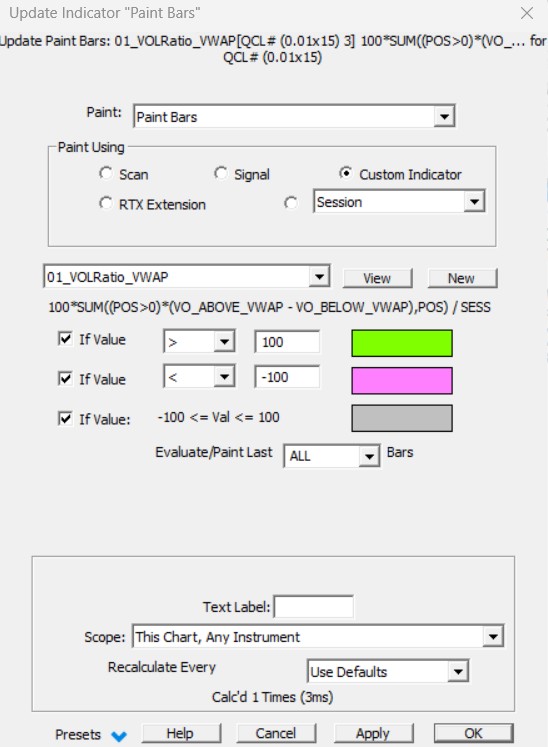
  • Paint Using... - You can base the bar painting on either a Scan, a Trading Signal, or a Custom Indicator.  The list below allows you to pick the specific Scan, Signal, or Custom Indicator.

  • View - This button will bring up the appropriate window to view or edit the object in the list to the left.

  • New - This button will allow you to create a new object based on whether you have Scan, Signal, or Custom Indicator chosen above.

  • If value > 0 (TRUE) - If this checkbox is checked, the bars will be drawn in the corresponding color when the expression above evaluates to a value of greater than 0.  Since TRUE is the equivalent of a numerical 1, TRUE is included in this group.

  • If value <= 0 (FALSE) - If this checkbox is checked, the bars will be drawn in the corresponding color when the expression above evaluates to a value of less than or equal to 0.  Since FALSE is the equivalent of a numerical 0, FALSE is included in this group.

  • Paint Bars / Paint Background - You may choose to either paint the bars themselves, or paint the background behind the bars.

  • Add Technicals to Chart - This button will add the technical indicators involved in the scan, signal, or indicator expression, to the chart.

 
The Description . . .
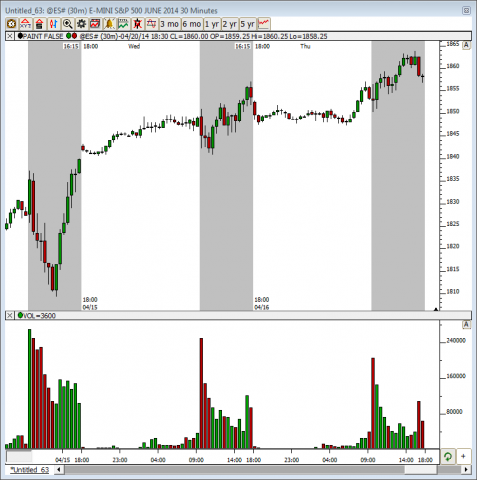
The Paint Bars indicator is a powerful tool for highlighting individual bars or groups of bars within a traditional bar chart. Normally, the bars in a traditional bar chart are drawn in one of two colors: an up color (typically green) and a down color (typically red). When a bar closes above the close of the previous bar, the bar is drawn using the up color, otherwise the bar is drawn in the down color.

When a Paint Bars indicator is added to a traditional bar chart window, you can elect to paint the actual bars or highlight the normal bars with specific background color(s) if some "condition" is true. The "condition" is specified by selecting a particular scan, trading signal, or custom indicator. For each bar in the chart, a scan or trading signal is either TRUE or FALSE. You can choose specific colors for both the true condition and the false condition. If a custom indicator is chosen as the painting criterion, then the custom indicator has an arithmetic value corresponding to each bar in the chart. Thus, three color choices are provided for positive, negative, and zero values of the indicator.

Here is a simple example. Suppose you wanted your intra-day bar charts to highlight periods of time during which the instrument is trading above the moving average of closing prices for the preceding 10 periods. First, create a "scan" named "Above MA" with the RTL formula:

CL > MA 

Where the MA moving average token is defined as a 10 period simple moving average.

Open an intra-day bar chart of some instrument and add a "Paint Bars" indicator to the chart. Setup the paint bars indicator to use the scan named "Above MA" created above. Specify "Paint Background" using the menu at the bottom of the Paint Bars setup window. Place a checkmark in the box to the left of the "TRUE" condition color box, then click on the color and pick a highlighting color for the TRUE condition. You could also specify a different color for the FALSE condition, but in this example, leave the checkbox to the left of the FALSE condition color box unchecked. Then click OK to add the Paint Bars indicator to the bar chart. You will see all bars that closed above the moving average are highlighted with the TRUE color chosen above.

To change the settings for a paint bars indicator, click the Edit Chart Element button on the charting toolbar and select the "Paint Above_MA" graph element. The setup window for the paint bars indicator will appear. Change the menu to read "Paint Bars" instead of "Paint Background". Change the TRUE condition color if you like to something different than the normal up/down colors you see in the chart, e.g. blue. Then click the Apply button to observe the effect (without closing the settings window). Notice that now the bars themselves are painted blue whenever the close is above the MA while other bars are painted normally using the up/down colors.

If you click the "Add Technicals to Chart" button, Investor/RT will determine which technical indicators are being used by the paint bar criterion. In this example, the MA technical indicator used in the "Above MA" scan will be added to the chart so you can verify visually that the highlighted bars do indeed close above the moving average.

Note that only one Paint Bars indicator should be added to a chart pane. If you add more than one, the first one will be used. To change the scan, signal, or custom indicator used to paint the bars, first delete the existing paint bars indicator, then add a new one using a different scan, signal, or custom indicator. 

If you revise the meaning of a particular scan, signal, or custom indicator that is currently being used to paint bars in one or more bar chart windows, the chart will update dynamically to reflect the revised meaning. In our example above, if you open the scan "Above MA" (using the Open: Scan command) and revise the MA token, changing it from a ten period to a twenty period moving average, and click the Save button, the chart window will re-paint automatically to highlight the bars closing above the 20-period moving average.

At present, the paint bars indicator only performs its task when the traditional chart is shown as a bar chart. If you temporarily switch the chart type to candlestick, or one of the line types, the highlighting will disappear. When you switch the chart back to a bar chart, the paint bars will once again highlight the chart window pane as appropriate.

New in 6.0
Traditional charts containing a Paintbars indicator will display grid lines properly in Investor/RT 6.0. In prior releases, one of the disadvantages of using the Paintbars indicator for chart background painting was that grid lines were overlaid by the background painting.