

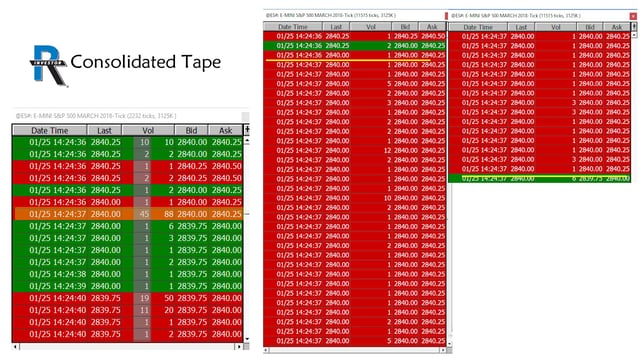
Watch the consolidated tape feature video
In version 13.2, Investor/RT introduced an important new data handling option titled Consolidated Tape for all users of the DTN IQFeed and DTN MA services. The Consolidated Tape option not only provides users the ability to see the tape in a clean, compact, and organized fashion, but also has a variety of very important efficiency and performance advantages.
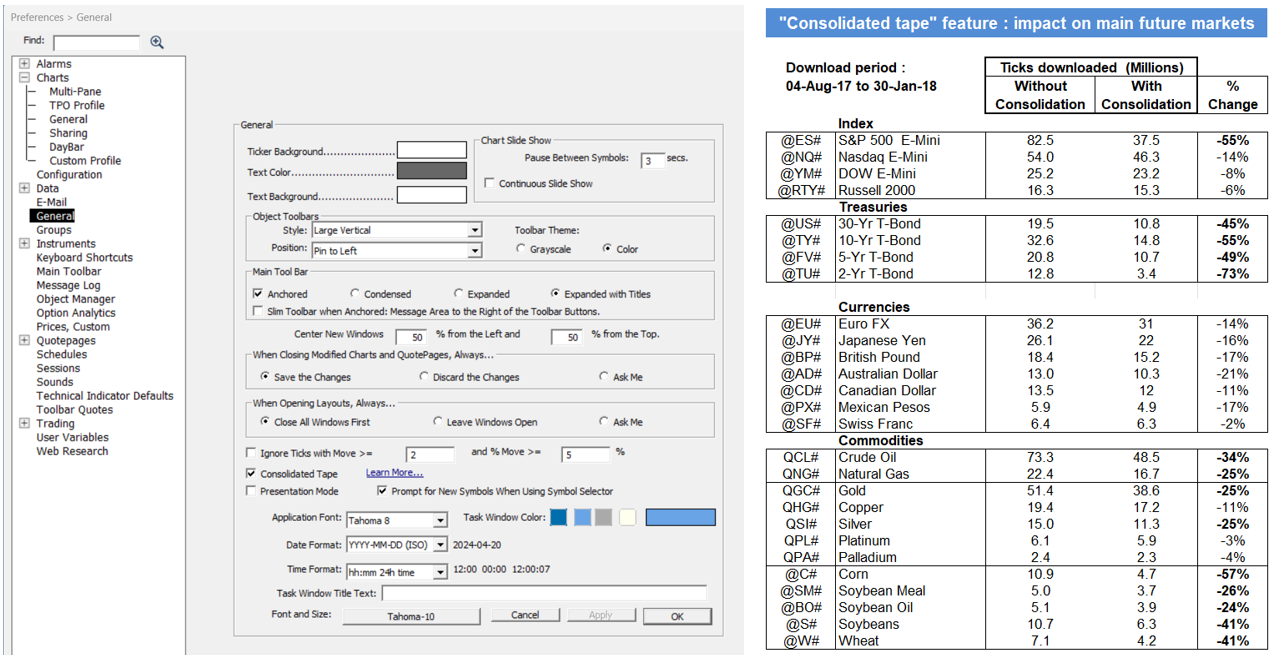
- For DTN IQfeed subscribers, this feature is activated by checking the corresponding option in File > Preference > General (see screenshot below)
- For DTN MA users with Rithmic as datafeed, please refer to the notice at the end of this page
In a nutshell, Consolidated Tape reassembles large trades that have been broken apart (by the CME exchange's order-matching algorithm) as they flow into Investor/RT. The presence of the DTN Tick ID enables this reconstruction for IQFeed & DTN MA subscribers.
Reminder: How does the CME Globex (MDP 3.0) system works ?
In this system, Market Orders (or Aggressive Limit Orders) are "broken apart" and split into multiple trade messages. Here is how this mechanism works:
- The "Aggressor" is the order being decomposed. When a market order enters the system and triggers an immediate execution against the order book, the CME matching engine identifies it as the Aggressor. If this order is large, it will not match a single block of contracts, but multiple smaller passive orders (Limit Orders) sitting at various price levels or belonging to different participants. Every decomposed transaction in the raw CME MPD 3.0 data stream shares the same Aggressor Side "Tag" (which is at the origin of the DTN tick ID)
- The CME "breaks" the execution of a large trades for two main reasons: due to the presence of multiple counterparties (a very large buy trades may be filled by multiple different sellers) or due to price sweeping (If an order is large enough to consume all liquidity at the "Best Ask" and must move to the next price level, the CME creates separate message blocks for each price level reached
Let's review a specific decomposition example
A trader may want to buy 88 contracts of ES, yet, there is no single buyer willing to sell that many contracts at that price. The bid is instead filled by 45 different sellers with small sizes varying from 1 to 3 lots. By default, this transaction flows from the data service into Investor/RT as 45 small trades.Consolidated Tape puts these 45 trades back together the instant they flow into Investor/RT and passes them along to charts as a single large trade.
What are the key benefits from the consolidated tape feature ?
1) A much better analysis of small vs large market participants
Many traders, however, are more interested in the fact that there was a single player on one side of this transaction. These broken trades all burst in at the same instant with the same bid, ask, and trade price (with varying sizes). This gives traders a more accurate picture of what big and small traders are doing throughout the many Investor/RT features that take advantage of volume size filtering (VolumeScope®, Volume Breakdown, Profile Indicator, Price and Bar Statistics, Trade Bubble, Trade Dots and much more) as highlighted in this video :
Trade Size filter feature video
2) A tremendous advantage in performance.
Over the course of any given second, 3 consolidated trades may hit each chart instead of 150 raw trades. Over the course of a week, 490k trades may hit each chart instead of 1.5 million trades. Several InvestorRT indicators are calculated on a tick-by-tick basis: reducing the number of ticks to be processed naturally results in a lighter CPU load and faster processing. Similarly, the initial loading time of charts will be significantly reduced.
When Consolidated Tape is turned on, backfill data will also be reconstructed. The table above provides the impact of this tick consolidation process over a 6 month period. The reduction in the number of ticks depends on each market characteristic, with S&P, Treasuries, and more generally commodities benefiting the most, performance-wise, from this new consolidation feature (which will also help reduce the size of the tick database being managed by IRT). Please note that tick reduction is typically more important during regular trading hours (vs the overnight session) and even more during market activity spikes (such as during economic news releases or the final minutes of the market cash session).
Important notice for subscribers using Rithmic as primary data feed and the DTN MA service (for historical data backfill)
On a limited number of servers (usually named "MPD 3.0 summary" or, just as the usual location followed by summary such as "Chicago Area Summary"), Rithmic is providing the same consolidated tick data as the one obtained using DTN IQ feed together with Investor/RT "consolidated tape" option. Connecting to such Rithmic servers brings the same trade analysis (ie identifying large player activity) and performance benefits as the one previously explained for DTN IQ feed subscribers. You will benefit from the exact reduction (in terms of number of tick to be processed by I/RT) as the IQ feed subscriber having checked the "consolidated tape" option..
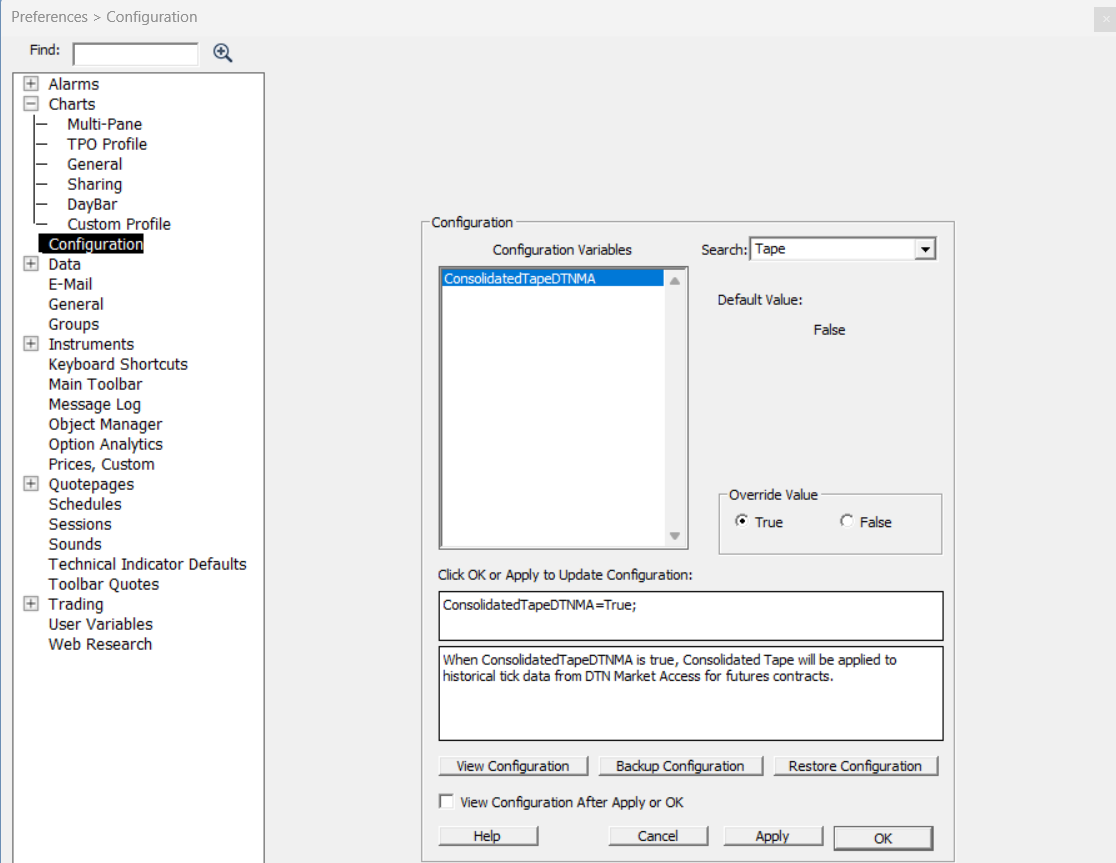
In that case, to have "consistent" consolidated tick data backfill from DTN MA, one needs to set the global configuration variable "ConsolidatedTapeDTNMA" to true.
Additional information :
- Volume Filter Chart (used in the video) : https://www.linnsoft.com/charts/volumefilter-es
- Rithmic setup guide: https://www.linnsoft.com/support/rithmic-market-data-and-order-routing
- CME MDP 3.0 data : https://www.cmegroup.com/confluence/display/EPICSANDBOX/CME+MDP+3.0+Mark...