
Home                           

 Try Investor/RT             

 Investor/RT Tour           

 Getting Started              

 What's New                  

 Testimonials                 


MASTER INDEX
  SEARCH
  CHARTS
  MAIN TOOLBAR
  SETTING PREFERENCES
  TECHNICAL INDICATORS
 
WHAT'S NEW
  ALARMS
  BACKTESTING

  CONFIRMING TRADES
  CUSTOM COLUMNS
  CUSTOM INDICATORS
  CUSTOM INSTRUMENTS
  CUSTOM PRICES
  DATA FEEDS
  DATABASE
  DOWNLOADING DATA
  FEED STATUS
  HEARTBEAT
  HELP
  MULTI-LINKING
  MULTI-PERIODICITY
 
INSTRUMENT SETUP
 
NASDAQ LEVEL II
 
NEWS TICKER
 
NEWS BROWSER
  OPTIMIZATION
  OPTIONS ANALYTICS

  PLACING TRADES
  PORTFOLIOS
  PRESETS
 
PRINTING
  QUICK QUOTES
  QUOTE PAGES
  REALIZATION
  RTL LANGUAGE
  SCANS
  SCHEDULES

  SCOPE
  SYSTEM STATUS
  TICKER TAPE
  TIME AND SALES

 
TRADING NOTES
  USER VARIABLES
  VERTICAL SCALE
MASTER INDEX
DICTIONARY
FEEDBACK

Investor/RT Tour ( more on Technical Indicators )
Accumulation/Distribution
The Formula . . . 

. . .more on Formulas 

SUM {[((CL - LO)-(HI - CL))/(HI - LO)] * VOL / DIVISOR}
 
The Presentation . . . 

. . . more on Charts 

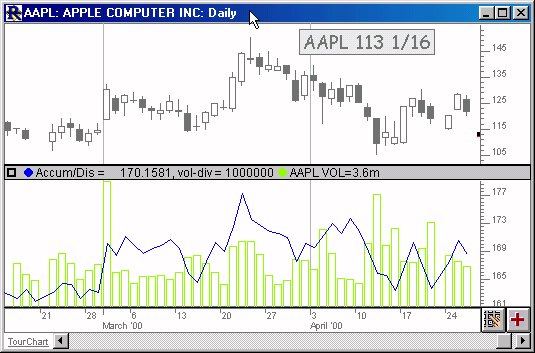
Accumulation/Distribution

The blue line above, in the lower window pane of the chart, represents the Accumulation/Distribution Line based on Daily data for RNWK.  The Accumulation/Distribution line is seen overlaying volume bars.
 
The Preferences . . . 

. . . more on Preferences 

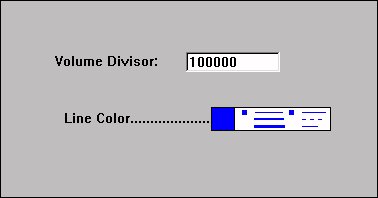
Accumulation Distribution Preferences

  • Volume Divisor (DIVISOR)- This divisor is used to keep the values of the technical indicator in a reasonable range for chart scaling purposes.  The volume will be divided by this number before being used in the formula.  If you would prefer not to use a divisor, simply enter a "1".

  • Line Color - This control allows you to choose the color and thickness of the line that represents the technical indicator in the chart.

 
The Description . . .
Accumulation/Distribution is a momentum indicator which takes into account changes in price and volume together. The idea is that a change in price coupled with an increase in volume may help to confirm market momentum in the direction of the price move.

Note the similarity of this formula to that of the stochastic; this is basically a stochastic multiplied by volume. This means that if the security closes near its high, the volume multiplier will have a greater effect than if the security closes nearer to its low.

If the Accumulation/Distribution indicator is moving up the buyers are driving the price move and the security is being accumulated. A decreasing A/D value implies that the sellers are driving the market and the security is being distributed. If divergence occurs between the Accumulation/Distribution indicator and the price of the security a change in price direction is probable.