
Home                           

 Try Investor/RT             

 Investor/RT Tour           

 Getting Started              

 What's New                  

 Testimonials                 


MASTER INDEX
  SEARCH
  CHARTS
  MAIN TOOLBAR
  SETTING PREFERENCES
  TECHNICAL INDICATORS
 
WHAT'S NEW
  ALARMS
  BACKTESTING

  CONFIRMING TRADES
  CUSTOM COLUMNS
  CUSTOM INDICATORS
  CUSTOM INSTRUMENTS
  CUSTOM PRICES
  DATA FEEDS
  DATABASE
  DOWNLOADING DATA
  FEED STATUS
  HEARTBEAT
  HELP
  MULTI-LINKING
  MULTI-PERIODICITY
 
INSTRUMENT SETUP
 
NASDAQ LEVEL II
 
NEWS TICKER
 
NEWS BROWSER
  OPTIMIZATION
  OPTIONS ANALYTICS

  PLACING TRADES
  PORTFOLIOS
  PRESETS
 
PRINTING
  QUICK QUOTES
  QUOTE PAGES
  REALIZATION
  RTL LANGUAGE
  SCANS
  SCHEDULES

  SCOPE
  SYSTEM STATUS
  TICKER TAPE
  TIME AND SALES

 
TRADING NOTES
  USER VARIABLES
  VERTICAL SCALE
MASTER INDEX
DICTIONARY
FEEDBACK

Investor/RT Tour ( more on Technical Indicators )
Adaptive Moving Average
The Formula . . . 

. . .more on Formulas 

Direction = Price - price(n)  ; where n = AMA Period
Volatility = Sum(abs(price - price[1], n)
Effeciency Ratio (ER) = Direction / Volatility
Fast Smoothing Constant (FastC) = 2/(p + 1) 
; where p = FSC Period
Slow Smoothing Constant (SlowC) = 2/(q + 1) 
; where q = FSC Period
Scaled Smoothing Constant (SSC) = ER(FastC - SlowC) + SlowC
c = SSC*SSC
AMA = AMA[1] + c(price - AMA[1]) 

See Also:  S&C, 1998 Bonus Issue, p. 34.

 
The Presentation . . . 

. . . more on Charts 

Adaptive Moving Average

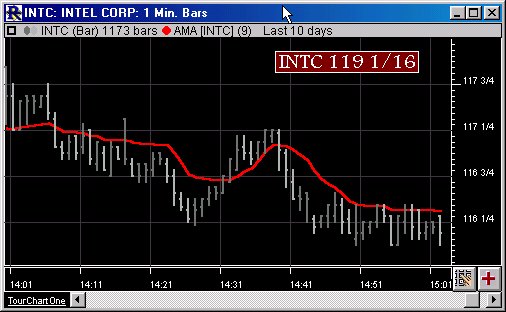
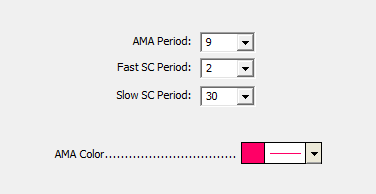
Above is a One Minute Bar Chart of Intel(INTC).  The Adaptive Moving Average is seen as a red line in the chart.  This moving average uses the preferences seen below.

 
The Preferences . . . 
. . . more on Preferences 

Adaptive Moving Average Preferences

  • AMA Period - Period used to calculate the Direction as seen in the formula above. (10 is recommended)

  • Fast SC Period - Period used to calculate the fast smoothing constant (2 is recommended)

  • Slow SC Period - Period used to calculate the slow smoothing constant (30 is recommended)

  • AMA Color - Color of the AMA line in the chart.

 
The Description . . .
This moving average moves slowly when prices are moving sideways and moves swiftly when prices move swiftly.  The basic rule is to buy when the AMA turns up, and sell when the AMA turns down.