
Home                           

 Try Investor/RT             

 Investor/RT Tour           

 Getting Started              

 What's New                  

 Testimonials                 


MASTER INDEX
  SEARCH
  CHARTS
  MAIN TOOLBAR
  SETTING PREFERENCES
  TECHNICAL INDICATORS
 
WHAT'S NEW
  ALARMS
  BACKTESTING

  CONFIRMING TRADES
  CUSTOM COLUMNS
  CUSTOM INDICATORS
  CUSTOM INSTRUMENTS
  CUSTOM PRICES
  DATA FEEDS
  DATABASE
  DOWNLOADING DATA
  FEED STATUS
  HEARTBEAT
  HELP
  MULTI-LINKING
  MULTI-PERIODICITY
 
INSTRUMENT SETUP
 
NASDAQ LEVEL II
 
NEWS TICKER
 
NEWS BROWSER
  OPTIMIZATION
  OPTIONS ANALYTICS

  PLACING TRADES
  PORTFOLIOS
  PRESETS
 
PRINTING
  QUICK QUOTES
  QUOTE PAGES
  REALIZATION
  RTL LANGUAGE
  SCANS
  SCHEDULES

  SCOPE
  SYSTEM STATUS
  TICKER TAPE
  TIME AND SALES

 
TRADING NOTES
  USER VARIABLES
  VERTICAL SCALE
MASTER INDEX
DICTIONARY
FEEDBACK

Investor/RT Tour ( more on Technical Indicators )
Moving Average Channels
The Formula . . . 

. . .more on Formulas 

Average = MA(PRICE, n)
Upper Channel = Average + m * SD[Average, x]
Lower Channel = Average - p * SD[Average, x]
where
   n = MA Period
   x = Std Dev Period
   m = number of Standard Deviations (upper)
   p = number of Standard Deviations (lower)
   SD = Standard Deviation over last x periods
 
The Presentation . . . 

. . . more on Charts 

Moving Average Channels

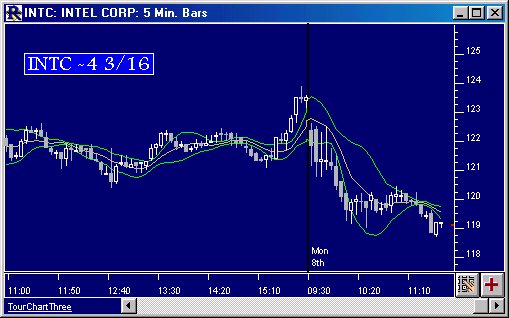
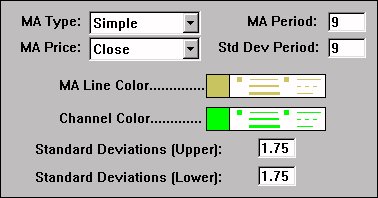
Above is a 5 Minute Candlestick Chart of an Intel Corporation (INTC).  The olive center line represents a Simple 9 Period Moving Average of the closing price, while the two green lines represent two channels based on the standard deviation settings in the preferences below.

 
The Preferences . . . 
. . . more on Preferences 

Moving Average Channel Prefences

  • MA Type - Moving Average Type used to compute the base (center) line.

  • MA Period - Moving Average Period used to compute the base (center) line.

  • MA Price - Prices on which to compute the moving average.

  • Std Dev Period - Number of periods (bars) used to compute the standard deviation of the price data.

  • MA Line Color - Color of the center moving average line.

  • Channel Color - Color of the moving average channel lines in the chart.

  • Standard Deviations (Upper) - Number of standard deviations used to draw the upper channel line.

  • Standard Deviations (Lower) - Number of standard deviations used to draw the lower channel line.

 
The Description . . .
Moving average channels use a moving average of price to create an envelope above and below the moving average line at a user specified number of standard deviations. The point of this study is to create a channel which represents support and resistance at its outer bounds based on the moving average. 

As always, the period of the moving average should match the trading time horizon of interest to the user. As price moves above its n-period moving average, a bullish indication is noted. Conversely, a price move below its x-period moving average is a bearish event. Using standard deviation to create a boundary above and below the moving average attempts to give the user a handle on how far the price has moved from the moving average in the past. 

The following approximations offer a few rules of thumb for using the standard deviation settings: 

Plus or minus one standard deviation takes in 68.3% of all expected outcomes 
Plus or minus two standard deviations takes in 95.4% of all expected outcomes 
Plus or minus three standard deviations takes in 99.7% of all expected outcomes 


In other words, you would expect to see a price move outside the moving average band using: 

one standard deviation: 1 in 3 chance
two standard deviations: 1 in 20 chance
three standard deviations: 1 in 370 chance

Using a standard deviation which includes 99.7% of all possible occurrences sets levels in the study which may never be tested. You may enter decimal numbers which enable you to adjust the sensitivity of the bands. Note that the standard deviation is a "moving standard deviation". The user may specify the period to use for the standard deviation calculation, usually, but not necessarily the same period as the moving average itself.