
Home                           

 Try Investor/RT             

 Investor/RT Tour           

 Getting Started              

 What's New                  

 Testimonials                 


MASTER INDEX
  SEARCH
  CHARTS
  MAIN TOOLBAR
  SETTING PREFERENCES
  TECHNICAL INDICATORS
 
WHAT'S NEW
  ALARMS
  BACKTESTING

  CONFIRMING TRADES
  CUSTOM COLUMNS
  CUSTOM INDICATORS
  CUSTOM INSTRUMENTS
  CUSTOM PRICES
  DATA FEEDS
  DATABASE
  DOWNLOADING DATA
  FEED STATUS
  HEARTBEAT
  HELP
  MULTI-LINKING
  MULTI-PERIODICITY
 
INSTRUMENT SETUP
 
NASDAQ LEVEL II
 
NEWS TICKER
 
NEWS BROWSER
  OPTIMIZATION
  OPTIONS ANALYTICS

  PLACING TRADES
  PORTFOLIOS
  PRESETS
 
PRINTING
  QUICK QUOTES
  QUOTE PAGES
  REALIZATION
  RTL LANGUAGE
  SCANS
  SCHEDULES

  SCOPE
  SYSTEM STATUS
  TICKER TAPE
  TIME AND SALES

 
TRADING NOTES
  USER VARIABLES
  VERTICAL SCALE
MASTER INDEX
DICTIONARY
FEEDBACK

Investor/RT Tour ( more on Technical Indicators )
Money Flow
The Formula . . . 

. . .more on Formulas 

See Description Below
 
The Presentation . . . 

. . . more on Charts 

Money Flow

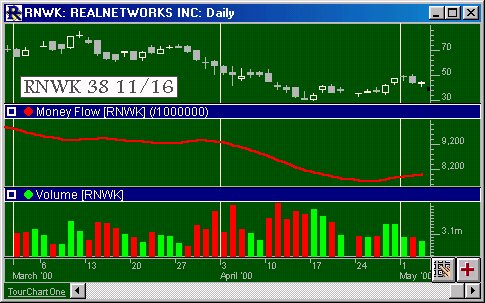
Above is a Daily Candlestick Chart of Real Networks (RNWK).  The red line in the middle pane represents the Money Flow, defined by the preferences below. The red and green bars in the middle lower pane represent the volume.
 
The Preferences . . . 

. . . more on Preferences 

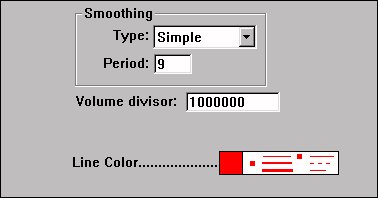
Money Flow Preferences

  • Smoothing Type - Type of moving average applied to the data after the money flow is calculated.

  • Smoothing Period - Moving average period applied to the data after the money flow is calculated.

  • Volume Divisor - A number used to divide the resulting money flow in order to bring it down to a more manageable number.

  • Line Color - Color of the money flow line in the chart.

 
The Description . . .
A technical indicator that keeps a running total of the money flowing into and out of a security. Money flow (MF) is calculated by multiplying the number of shares traded by the change in closing price. If prices close higher, money flow increases (by an amount equal to average price * volume / volume divisor). If prices close lower, money flow decreases (by an amount equal to average price * volume / volume divisor). Average price is equal to the average of the high, low, and closing prices.  A running total is kept by adding or subtracting the current result from the previous total.  A volume divisor is used to keep the actual numbers at a reasonable level

The direction of the Money Flow line is the important component to watch, not the actual dollar amount.  The indicator can be used to confirm underlying strength or weakness of a price trend.  When Money Flow rises in the face of a declining price trend could indicate smart money is moving in and a bottom may be at hand, and visa versa.

The calculation would go as follows:

if (AVG > AVG1) MF += (VOL * AVG) / VOLDIVISOR;
else if (AVG < AVG1) MF -= (VOL * AVG) / VOLDIVISOR;
else MF = MF1;

where AVG = (HI + LO + CL) / 3
and AVG1 is the AVG of the last bar (1 bar back)