
Home                           

 Try Investor/RT             

 Investor/RT Tour           

 Getting Started              

 What's New                  

 Testimonials                 


MASTER INDEX
  SEARCH
  CHARTS
  MAIN TOOLBAR
  SETTING PREFERENCES
  TECHNICAL INDICATORS
 
WHAT'S NEW
  ALARMS
  BACKTESTING

  CONFIRMING TRADES
  CUSTOM COLUMNS
  CUSTOM INDICATORS
  CUSTOM INSTRUMENTS
  CUSTOM PRICES
  DATA FEEDS
  DATABASE
  DOWNLOADING DATA
  FEED STATUS
  HEARTBEAT
  HELP
  MULTI-LINKING
  MULTI-PERIODICITY
 
INSTRUMENT SETUP
 
NASDAQ LEVEL II
 
NEWS TICKER
 
NEWS BROWSER
  OPTIMIZATION
  OPTIONS ANALYTICS

  PLACING TRADES
  PORTFOLIOS
  PRESETS
 
PRINTING
  QUICK QUOTES
  QUOTE PAGES
  REALIZATION
  RTL LANGUAGE
  SCANS
  SCHEDULES

  SCOPE
  SYSTEM STATUS
  TICKER TAPE
  TIME AND SALES

 
TRADING NOTES
  USER VARIABLES
  VERTICAL SCALE
MASTER INDEX
DICTIONARY
FEEDBACK

Investor/RT Tour ( more on Technical Indicators )
Money Flow Index
The Formula . . . 

. . .more on Formulas 

See Description Below
 
The Presentation . . . 

. . . more on Charts 

Money Flow Index

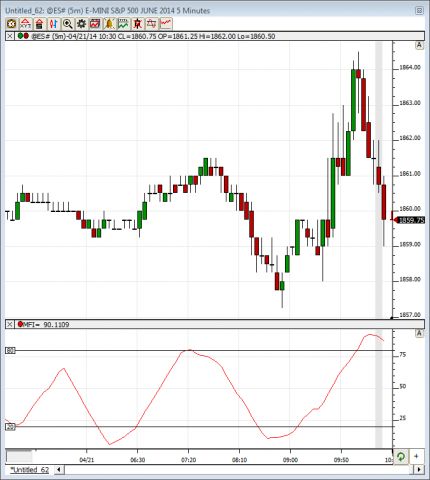
Above is a Daily Candlestick Chart of Apple Computers (AAPL).  The blue line in the lower window pane represents the Money Flow Index, defined by the preferences below. The red and green bars in the middle pane represent the volume.

 
The Preferences . . . 

. . . more on Preferences 

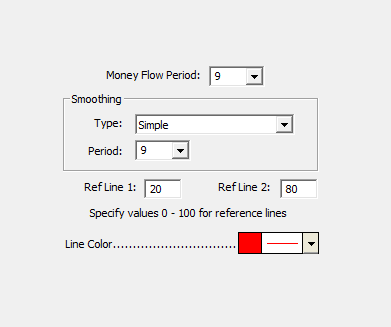
Money Flow Index Preferences

  • Smoothing Type - The smoothing type used to smooth the resulting MFI values.

  • Smoothing Period - The smoothing period used to smooth the resulting MFI values.

  • Money Flow Period - Number of bars used to compute each MFI value.

  • Ref Line (1, 2) - Horizontal Reference Line values.

  • Line Color - Color used for the MFI line in the chart.

 
The Description . . .
The Money Flow Index creates a ratio of Positive Money Flow and Negative Money Flow over time and scales it to a number between 0 and 100. The MFI value can be used to evaluate overbought and oversold conditions in a security the index moves above or below a certain reference level (Investor/RT defaults to 80 for overbought and 20 for oversold).

Divergence between MFI and the price direction can also be indicative of a reversal. If price is trending higher and MFI is decreasing over that period, a market top may occur.

Here is an example of a Money Flow Index calculation.  Let's say you have specified a period of 10, and you are adding your indicator to a daily chart.  For each bar, a money flow value is calculate by multiplying the volume by the average price (HI + LO + CL) / 3.  If the closing price of the bar is greater than the closing price of the previous bar, then the money flow is considered positive money flow.  If the closing price of the bar is less than the closing price of the previous bar, then the money flow is considered negative money flow.  If the price is unchange, the money flow is not considered in the calculation of the money flow index.  The money flow index is calculated by summing up all the positive money flows into one value (PMF) and all the negative money flows into another value (NMF) over the 10 bar period, and then using these values in the following equation:

MFI = 100.0 - (100.0 / (1.0 + (PMF / NMF)))

The resulting MFI is then smoothed using the smoothing parameters specified.  In the case above, it is smoothed with a 7 period simple moving average.  To remove smoothing, just specify a 1 period moving average.

The result is always a value between 0.0 and 100.0