
Home                           

 Try Investor/RT             

 Investor/RT Tour           

 Getting Started              

 What's New                  

 Testimonials                 


MASTER INDEX
  SEARCH
  CHARTS
  MAIN TOOLBAR
  SETTING PREFERENCES
  TECHNICAL INDICATORS
 
WHAT'S NEW
  ALARMS
  BACKTESTING

  CONFIRMING TRADES
  CUSTOM COLUMNS
  CUSTOM INDICATORS
  CUSTOM INSTRUMENTS
  CUSTOM PRICES
  DATA FEEDS
  DATABASE
  DOWNLOADING DATA
  FEED STATUS
  HEARTBEAT
  HELP
  MULTI-LINKING
  MULTI-PERIODICITY
 
INSTRUMENT SETUP
 
NASDAQ LEVEL II
 
NEWS TICKER
 
NEWS BROWSER
  OPTIMIZATION
  OPTIONS ANALYTICS

  PLACING TRADES
  PORTFOLIOS
  PRESETS
 
PRINTING
  QUICK QUOTES
  QUOTE PAGES
  REALIZATION
  RTL LANGUAGE
  SCANS
  SCHEDULES

  SCOPE
  SYSTEM STATUS
  TICKER TAPE
  TIME AND SALES

 
TRADING NOTES
  USER VARIABLES
  VERTICAL SCALE
MASTER INDEX
DICTIONARY
FEEDBACK

Investor/RT Tour ( more on Technical Indicators )
Keltner Channels
The Formula . . . 

. . .more on Formulas 

Center Line:  MA(CL, Period, Type)
Hi Band:  Center Line + MA(True Range, Period, Type) * HiMultiplier
Lo Band:  Center Line - MA(True Range, Period, Type) * LoMultiplier
 
The Presentation . . . 

. . . more on Charts 

Keltner Channels

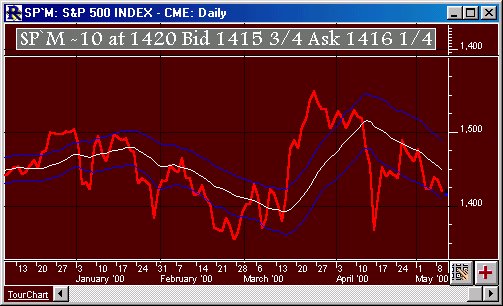
Above is a Daily Line Chart of an S&P 500 Future contract (SP`M) .  The white line is the center line of the Keltner study, while the Blue lines represent the high and low bands, based on the preferences specified below.
 
The Preferences . . . 

. . . more on Preferences 

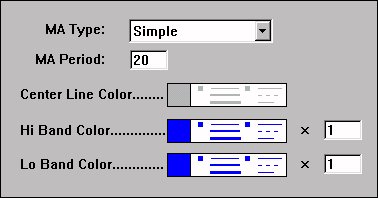
Keltner Channels Preferences

  • MA Type - Moving Average type, which is applied to both the true range, and the closing price in the calculation.

  • MA Period - Moving Average period, which is applied to both the true range, and the closing price in the calculation.

  • Center Line Color - Color of the Center Line.

  • Hi Band Color - Color of the High Band.

  • Lo Band Color - Color of the Low Band.

 
The Description . . .
The Keltner Channel is a volatility-based indicator which makes us of the "envelope theory" and uses the range of high and low.  Moving average bands and channels, like the Keltner Channels, all fall into the general category of envelopes.  Envelopes consist of three lines:  a middle line and two outer lines. Envelope theory states that the price will most likely fall within the boundaries of the envelope.  If prices drift outside our envelope, this is considering and anomaly and a trading opportunity.  In the case of Keltner Channels, when the price touches or moves past either of the outer bands, a reaction toward the opposite band can be expected.  When price reaches the upper band, it is believed to be overbought, and when price reaches the lower band, it is believed to be oversold.