
Home                           

 Try Investor/RT             

 Investor/RT Tour           

 Getting Started              

 What's New                  

 Testimonials                 


MASTER INDEX
  SEARCH
  CHARTS
  MAIN TOOLBAR
  SETTING PREFERENCES
  TECHNICAL INDICATORS
 
WHAT'S NEW
  ALARMS
  BACKTESTING

  CONFIRMING TRADES
  CUSTOM COLUMNS
  CUSTOM INDICATORS
  CUSTOM INSTRUMENTS
  CUSTOM PRICES
  DATA FEEDS
  DATABASE
  DOWNLOADING DATA
  FEED STATUS
  HEARTBEAT
  HELP
  MULTI-LINKING
  MULTI-PERIODICITY
 
INSTRUMENT SETUP
 
NASDAQ LEVEL II
 
NEWS TICKER
 
NEWS BROWSER
  OPTIMIZATION
  OPTIONS ANALYTICS

  PLACING TRADES
  PORTFOLIOS
  PRESETS
 
PRINTING
  QUICK QUOTES
  QUOTE PAGES
  REALIZATION
  RTL LANGUAGE
  SCANS
  SCHEDULES

  SCOPE
  SYSTEM STATUS
  TICKER TAPE
  TIME AND SALES

 
TRADING NOTES
  USER VARIABLES
  VERTICAL SCALE
MASTER INDEX
DICTIONARY
FEEDBACK

Investor/RT Tour ( more on Technical Indicators )
Ultimate Oscillator
The Formula . . . 

. . .more on Formulas 

if (Y1 = 0 or Y2 = 0 or Y3 = 0)
  UltOsc = 0
else
  UltOsc = ((X1 / Y1) * 4 + (X2/ Y2) * 2 + (X3 / Y3)) / 7

where
X1 = Average (Close - TrueLow, period1)
X2 = Average (Close - TrueLow, period2)
X3 = Average (Close - TrueLow, period3)
Y1 = Average (TrueRange, period1)
Y2 = Average (TrueRange, period2)
Y3 = Average (TrueRange, period3)

 
The Presentation . . . 

. . . more on Charts 

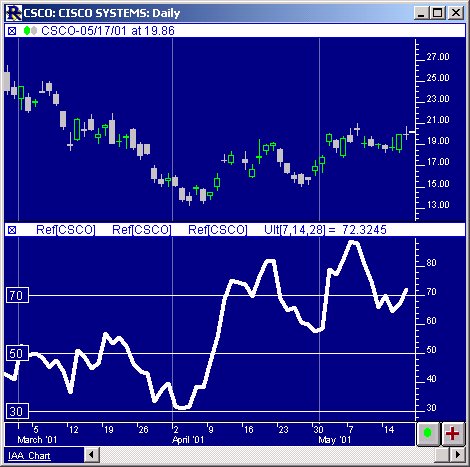
Above is a Daily Candlestick Chart of Cisco Systems (CSCO).  The white line in the lower pane represents the oscillator, based on the preferences below.

 
The Preferences . . . 
. . . more on Preferences 

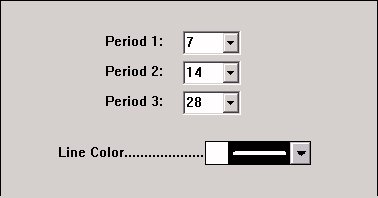
  • Period 1 - Short-term period used in calculations above.

  • Period 2 - Intermediate-term period used in calculations above..

  • Period 3 - Long-term period used in calculations above.

  • Line Color - Color of the ultimate oscillator in the chart.

 
The Description . . .
The Ultimate Oscillator was designed by Larry Williams in an attempt to improve on the premature buy and sell signals he observed in other available oscillators.   It is documented in the April, 1985 issue of Technical Analysis of Stocks & Commodities.  The calculation of the oscillator can be seen above.  The Ultimate Oscillator combines three oscillators that represent short-, intermediate- and long-term market cycles (7-, 14-, & 28-periods are recommended).  Mr. Williams’ theory is there is a bullish divergence when price makes a lower low that is not confirmed by a lower low in the UltOsc. A bearish divergence occurs when price makes a higher high that is not confirmed by a higher high in the UltOsc. A bullish divergence occurs when price makes a lower low that is not confirmed by a lower low in the oscillator. A bearish divergence occurs when price makes a higher high that is not confirmed by a higher high in the oscillator.

Williams suggests the following regarding buy and sell signals.

  1. Buy on positive divergence where the low of the oscillator has dipped below 30.
  2. Sell on negative divergence where the high has exceeded 50.
  3. Close long positions when the oscillator exceeds 70.
  4. Close short positions when the oscillator goes below 30.