
|

MASTER INDEX
SEARCH
CHARTS
MAIN TOOLBAR
SETTING PREFERENCES
TECHNICAL
INDICATORS
WHAT'S NEW
ALARMS
BACKTESTING
CONFIRMING TRADES
CUSTOM
COLUMNS
CUSTOM
INDICATORS
CUSTOM
INSTRUMENTS
CUSTOM PRICES
DATA FEEDS
DATABASE
DOWNLOADING
DATA
FEED STATUS
HEARTBEAT
HELP
MULTI-LINKING
MULTI-PERIODICITY
INSTRUMENT SETUP
NASDAQ LEVEL II
NEWS TICKER
NEWS BROWSER
OPTIMIZATION
OPTIONS
ANALYTICS
PLACING TRADES
PORTFOLIOS
PRESETS
PRINTING
QUICK
QUOTES
QUOTE PAGES
REALIZATION
RTL LANGUAGE
SCANS
SCHEDULES
SCOPE
SYSTEM STATUS
TICKER
TAPE
TIME AND SALES
TRADING NOTES
USER VARIABLES
VERTICAL SCALE
MASTER INDEX
DICTIONARY
FEEDBACK
Indicator-A-Day
24.
Volume Breakdown
23. PriceTime
Cycles
22. Trend
Intensity Index
21. Bollinger
Bands
20. Balance
of Power
19. RSI
18. Fib
Retracements
17. Parabolic
SAR
16. CCI
15. ADXR
14. ADX
13. DI+
/ DI-
12. True
Range
11. Stochastics
10. Statistics
9. TLB
Oscillator
8.
Weighted
MA
7.
Exponential
MA
6. Moving
Average
5.
Regression
Review
4.
Reg
Acceleration
3.
Regression
Slope
2.
Regression
Bands
1.
Linear Regression
|
Investor/RT Tour
( more on Technical
Indicators )
Fibonacci Retracements
| The Formula
. . . |
. . .more
on Formulas |
See Description Below
Note: For historical Auto-Fibonacci
Retracements - see Retracement-Based Stochastics |
| |
| The
Presentation . . . |
. . . more
on Charts |
|

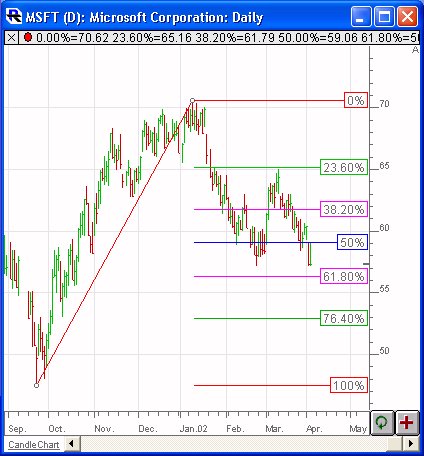
Above is a Daily Chart of an Microsoft Corporation
(MSFT). The diagonal red line represents a trendline between two extreme points, based on the date-time ranges specified below. The horizontal trendlines represent the Fibonacci Levels selected in the preferences below. |
|

|
| The
Preferences . . . |
. . . more
on Preferences |
|
|
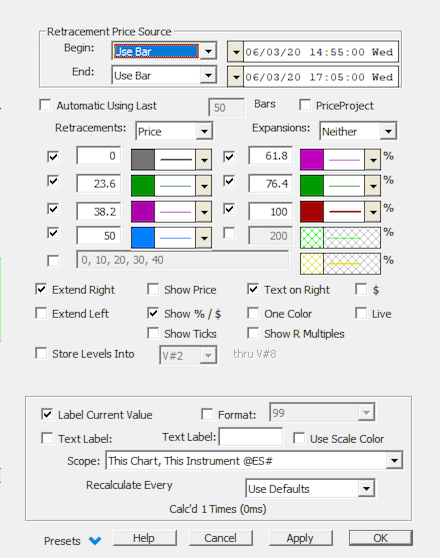
-
Retracement Price
Source - Specifies what method will be used for
identifying the beginning and ending points of the retracement trendline.
-
Begin/End - The
preferences labeled "Begin" or "End" have
different meanings based on which Price Source checkbox is
selected. If "Use Bars" is selected,
then Begin or End will represent the beginning or ending dates
that will be used as endpoints to the trendline. The
extreme price of the bar will be used as the endpoint price. If
"Use Price" is selected, then Begin or End
will represent the beginning or ending prices of the
trendline. If "Use Variables" is selected, then
Begin and End will be a choice of variable prices, including
High, Low, and the V# custom variables. Begin and End are
not used for Automatic Retracements.
-
Use Bar
- This option allows the user to specify the date/times of
the bars that will be used for the retracement trendline.
The prices will be determined based on the high of the higher
bar, and the low of the lower bar.
-
Use Price
- This option allows the user to use specific prices as
trendline endpoints, independent of the highs and lows of the
actual bar data.
-
Use Variable
- This option allows the user to link the trendline
endpoints to different variables, including the High and Low of
the day, or any of the custom V# variables. By giving the
user access to the V# custom variables, the user may set the
endpoints to essentially any data accessible using RTL.
-
Automatic
Using Last X bars - This option provides for an auto-fib
retracement capability. If this options is checked, then a
trendline will automatically be drawn from the highest high to
the lowest low over the past X bars, and then the Fibonacci
levels will be drawn off this.
-
Price Projections
- This turns the Fibonacci Tool into a Price Projection
tool. In this mode, it will use only one price, and base
it's retracements off retracements from that price down to
zero. If the price is 100.0, then a 10% retracement line
would be drawn at 90, while a 20% projection line would be drawn
at 120. It gives the user an ability to draw multiple
reference lines all based off one common price. More
on Price Projections.
-
Retracement - Retracement
options include Price, Time, Both, and Neither. Price
Retracement lines are horizontal lines retracing from then
ending price of the trendline back towards the beginning price
of the trendline. Time retracement lines are vertical
lines retracing from the ending date/time back towards the
beginning date/time of the trendline. A 70% Price
Retracement line drawn on a fib trendline going from $60 to $70
will be drawn as a horizontal line at $63.
-
Expansions - Expansion
options include Price, Time, Both, and Neither. Price
Expansion lines are vertical lines projecting past the ending
price. Time expansion lines are vertical lines projecting
forward in time past the ending date/time. A 50% Time
Expansion drawn on a fib trendline that spans 50 bars, will be
drawn as a vertical line 25 bars (50% of 50) past the endpoint
of the trendline.
-
- Dictates whether that retracement level will be
draw in the chart. The last and longest entry box allows
the user to enter comma or space delimited numbers for
additional retracement levels.
-
% Levels - Fib
percent levels at which to draw the horizontal lines.
These levels can also be $ levels if the "$" checkbox
is checked. See "$ (Use Absolute Dollar
Retracement)" below.
-
Color - Color
and style of the retracement lines in the chart. Each level can have
it's own color and width. If the "One Color"
checkbox is checked, then all but one color control will be
hidden, and that color will be used for all lines.
-
Extend Right
- Extend
the retracement lines to the right edge of the chart.
-
Extend Left - Extend
the retracement lines to the left edge of the chart.
-
Show %/$ - Show
the % or $ retracement or expansion levels of each line.
-
Show Price -
Show the price of each line.
-
Text on Right
- Place the text labels on the right side of the chart.
-
One Color -
Allow the user to specify only one color for all retracement
lines, as opposed to unique color for each. When check,
all color controls except one will be hidden.
-
$ (Use Absolute Dollar
Retracements) - This option changes your
retracement levels from % levels to absolute $ levels. For
instance, if your trendline is drawn from 10 to 20, in the %
mode, a retracement of 10(%) would bring you back to 19, while
in the $ mode, a retracement of 10($) would bring you back to
10.
-
Live - When
this option is checked, a line is drawn at the right edge of the
chart showing the actual percent retracement level of the current bar.
This value/line updates dynamically as price changes.
|
| |
| The
Description . . . |
| The Fibonacci Retracement / Expansion
study is a very flexible tool in Investor/RT, allowing for drawing
of both retracement and expansion lines, based on either price
(horizontal), time (vertical), both. The Fibonacci trendline
endpoints can be automated, can be user specified, can snap to
extreme prices, or can even be set automatically to any custom value
using a scan. Over 16 custom retracement/expansion levels can be
drawn with each instance of the study. The price retracements can be
based on either % levels, or absolute price ($).
Fibonacci Retracements are displayed by first drawing a trendline between two extreme points, for example, a trough and opposing peak. A series of
8 or more horizontal lines can be drawn intersecting the trendline at the Fibonacci levels of 0.0 percent, 23.6 percent, 38.2 percent, 50 percent, 61.8 percent, 100 percent, 161.8 percent, 261.8 percent,
or whatever custom levels you prefer. Levels can be specified
in unit of % or $.
After a significant move, (either up or down), prices will often retrace a significant portion (if not all) of the original move. As prices retrace, support and resistance levels often occur at or near the Fibonacci Retracement levels.
A new checkbox (labeled "$") in the lower right hand corner of the Fibonacci Retracement preference allows the user to setup the study to use absolute price retracements as opposed to % retracements. Typically, the Fibonacci retracement interprets the levels as % levels on which to draw retracement lines. With the absolute price retracement option checked, the retracement lines will be drawn at absolute price distances from the endpoint. This option in combination with the Price Projection option gives the user to draw multiple horizontal reference lines at specific price levels throughout the chart.
Fibonacci Retracements now maintain their high or low prices and positions properly when switching periodicities, regardless of the price sources specified. In the past, when using the "Use Bar" option, switching intraday periodicities could sometimes result in slightly altering the price of the endpoints. Now, when switching from a 10-minute chart to a 1-minute chart, for instance, the endpoints will maintain their high and low positions, and attach themselves to the proper 1-minute bars which contain those highs and lows. Switching back to a 10-minute chart will again
maintain the original 10-minute prices and endpoints.
Retracement Price Source - The user has a great deal of
flexible automation available in determining the endpoints of the
retracement trendline. Four options are available. The "Use
Bars" option
allows the user to specify the date/times of the bars that will be
used for the retracement trendline. The prices will be
determined based on the high of the higher bar, and/or the low of the
lower bar. When dragging and dropping, the endpoints will snap
to the high or low of the bar on which it is dropped. "Use
Price" allows the user to use specific prices as
trendline endpoints, independent of the highs and lows of the actual
bar data. This option should be specified if the user wants
complete flexibility over where the endpoints can be dragged and
dropped. "Use Variables"
allows the user to link the trendline endpoints to different
variables, including the High and Low of the day, or any of the
custom V# variables. By giving the user access to the V#
custom variables, the user may set the endpoints to essentially any
data accessible using RTL. "Automatic
Retracement Using last X bars" provides for an auto-fib
retracement capability and is discussed further below.
Automatic Fibonacci Retracments - If you select the
"Use last X bars" option, then your Fibonacci trendline
becomes automated and can then change dynamically as new prices come
into the chart. The Fibonacci trendline will be drawn from the
highest high over the period specified to the lowest low, and the
resulting retracement levels will then be draw respectively.
The trendline, and thus the retracement levels, can change with each
new tick and each new bar. The Begin and End date-times will
be ignored in this situation, as the indicator always be based on
the most recent period of bars. As a new bar comes into the
picture for consideration, an old one is no longer considered.
|
| |
| RTL
Token . . . FIBR ( more
) |
The Auto-Fibonacci Retracement study has been added to the RTL language in the form of the token
FIBR. The FIBR token represents the % retracement level based on an automated trendline connected the high and low extremes of the retracement period specified in the preferences. The only preferences that is used for the FIBR token is the auto-retracement
period along with a checkbox labeled "Use Hi/Lo". If a period of 50 is specified, for instance, then Investor/RT looks back over the past 50 bars and finds the highest high and lowest low and constructs trendline between these two. Then, the FIBR result is computed as the percent that the current price has retraced from the endpoint of the trendline vertically back toward the starting point.
If the "Use Hi/Lo" checkbox is checked, then the high or
low value of the current bar will be used when determining the
retracement level. If the Fibonacci trendline slope is
positive, then the low will be used, while a negative slope dictates
the high will be used.
|
| Keyboard
Adjustment . . . |
The keyboard can be used to move the
Fibonacci points to the right and left. First, click on the
chart. Then hit the tab key repeatedly until you notice your
Fibonacci Retracement lines are selected. Then, press the
right or left arrow keys on your keyboard to move the entire
Fibonacci line right or left one bar. To move the trendline up
or down, press the up and down arrows on the keyboard. If you would like to
move only the endpoint, then hold down the Ctrl key while pressing
the right or left arrow keys. If you would like to move only
the beginning point, then hold down the Shift key while pressing the
right or left arrow keys. For more information on technical
indicator adjustment, click here.
|
| User
Strategies . . . |
| If you have a User Strategy you'd like to
share, please email to support@linnsoft.com
|
| |
04/03/02 |
| |
|
|
|