
| The Formula
. . . |
. . .more
on Formulas |
|
FISH = 0.5*LOG((1+Value)/(1-Value))+0.5*FISH.1
Value = 0.33*2*((Price - MinLo)/(MaxHi - MinLo) - 0.5)+0.67*Value.1
MinLo = Min(Lo, Period)
MaxHi = Max(Hi, Period)
Price = User Specified (Hi+Lo/2 is recommended)
Period = User Specified (10 is recommended)
|
| |
| The
Presentation . . . |
. . . more
on Charts |
|

|
| |
| The
Preferences . . . |
. . . more
on Preferences |
|

|
-
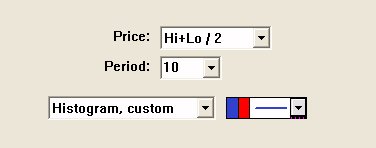
Price - Price
value used as input for the computation. Options include Open, Close, High, Low,
HI+LO/2, HI+LO+CL/3, O+H+L+C/4, %Change, or OP+CL/2.
-
Period -
Period used to compute the maximum high and minimum low in the
calculation above.
|
| |
| The
Description . . . |
|
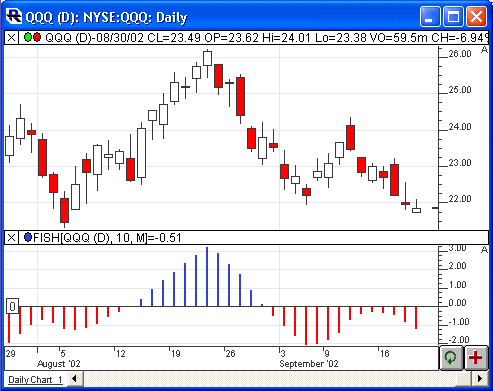
Fisher Transform (FISH) is based on the article "Using The
Fisher Transform" by John Ehlers that will be available in the
November 2002 issue of Stocks and Commodities Magazine. FISH
has sharp and distinct turning points that occur in a timely
fashion. It is based on the assumption that prices do not have
a Gaussian probability density function (PDF), but you can create a
nearly Gaussian PDF for prices by normalizing price, or an indicator
such as RSI, and applying the Fisher Transform. The resulting
peak swings clearly identify price reversals.
|
| Keyboard
Adjustment . . . |
| The Fisher
Transform period can be adjusted directly from the keyboard without
having to open up the preferences window. Just select the
indicator and then hit the up or down keys on your keyboard to
adjust the period. The up arrow key increases the period by 1 while the down arrow key
decreases the periods by 1.
For more information on technical
indicator adjustment, click here.
|
| RTL
Token . . . FISH ( more
) |
|
The Fisher Transform can be referenced in the RTL
language using the token FISH. To scan for the bullish signal
(swing low) of the FISH turning up below the -1 line, use the following syntax:
FISH < -1 AND FISH > FISH.1 AND FISH.1 <= FISH.2
And to scan for the bearish signal (swing high) of FISH turning down
above the 1 line, use the following syntax:
FISH > 1 AND FISH < FISH.1 AND FISH.1 >= FISH.2
|
|